Interfaces
Interfaces in Low-Level Design, exploring decoupling, coding to an interface, and the difference between interfaces and abstract classes.
In object-oriented system design, we often need to define how different components interact without locking ourselves into specific implementations.
An Interface acts as a contract. It defines a set of behaviors (methods) that a class agrees to provide, without specifying how those behaviors are implemented.
This article covers why interfaces are essential for loose coupling, how they enable polymorphism, and how they differ from abstract classes.
Coding to an Interface
A core design guideline in low-level design is: Code to an interface, not an implementation.
When a class depends directly on another concrete class, they are tightly coupled. If we want to change or swap that dependency later, we have to modify the calling class, violating the Open-Closed Principle.
The Anti-Pattern: Tight Coupling
Here, our NotificationService depends directly on a concrete EmailSender:
// Concrete dependency
public class EmailSender {
    public void send(String message) {
        System.out.println("Sending email: " + message);
    }
}

public class NotificationService {
    private EmailSender sender = new EmailSender(); // Tightly coupled!

    public void notifyUser(String message) {
        sender.send(message);
    }
}
If we want to start sending SMS notifications instead of emails, we have to change the code inside NotificationService.
The LLD Pattern: Loose Coupling
By introducing an interface, we break the direct dependency between the calling service and the sender logic.
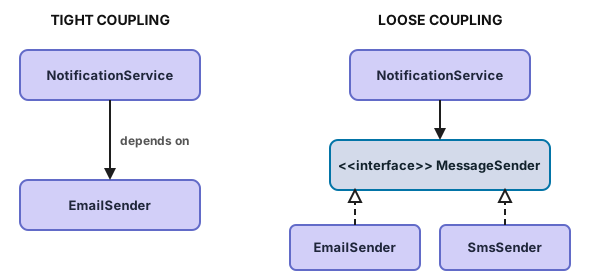
[!TIP] Reading the UML Notation:
- Solid Line + Solid Arrowhead (Dependency): Indicates that one class uses or depends on another (e.g.,
NotificationServicedepends onMessageSender).- Dashed Line + Hollow Triangle (Realization/Implementation): Indicates that a class implements an interface contract (e.g.,
EmailSenderimplementsMessageSender).
// 1. Define the interface contract
public interface MessageSender {
    void send(String message);
}

// 2. Implement the contract
public class EmailSender implements MessageSender {
    @Override
    public void send(String message) {
        System.out.println("Sending email: " + message);
    }
}

public class SmsSender implements MessageSender {
    @Override
    public void send(String message) {
        System.out.println("Sending SMS: " + message);
    }
}

// 3. Depend on the interface
public class NotificationService {
    private final MessageSender sender;

    // Dependency is injected at runtime
    public NotificationService(MessageSender sender) {
        this.sender = sender;
    }

    public void notifyUser(String message) {
        sender.send(message);
    }
}
// Client usage:
NotificationService emailService = new NotificationService(new EmailSender());
emailService.notifyUser("Hello via Email!");
NotificationService smsService = new NotificationService(new SmsSender());
smsService.notifyUser("Hello via SMS!");Now, NotificationService is completely decoupled. We can pass either EmailSender or SmsSender into its constructor without changing a single line of code inside NotificationService.
Interface vs. Abstract Class
A common design question is when to use an interface versus an abstract class. The distinction is about intent:
| Feature | Interface | Abstract Class |
|---|---|---|
| Relationship | Defines capability ("can-do"). E.g., Serializable, Runnable. | Defines identity ("is-a"). E.g., Animal -> Dog. |
| Multiple Inheritance | A class can implement multiple interfaces. | A class can extend only one abstract class. |
| State (Fields) | Cannot hold mutable instance state (only static final constants). | Can hold both mutable instance state (instance fields) and constants. |
| Constructors | Cannot have constructors. | Can have constructors (to initialize base state). |
Design Guideline:
- Use Abstract Classes when you want to share common state and code layout among closely related subclasses.
- Use Interfaces when you want to define a common behavior contract across completely unrelated classes (e.g., both a
Userclass and aDatabaseBackupclass can implementSerializable).
Summary
- Contract: Interfaces define behavior contracts without enforcing implementation details.
- Loose Coupling: Depending on interfaces instead of concrete classes allows dependencies to be swapped easily.
- Interface vs. Abstract Class: Interfaces specify capabilities ("can-do"); abstract classes specify taxonomic relationships ("is-a") with shared state.