Enums (Enumerations)
Enums in Low-Level Design, exploring state management, constant-specific behavior, and domain modeling.
When designing software systems, we frequently encounter situations where a variable can only hold one of a fixed, predetermined set of values. Examples include order statuses (PENDING, SHIPPED, DELIVERED), user roles (ADMIN, EDITOR, VIEWER), or math operations (ADD, SUBTRACT).
In Low-Level Design (LLD), we use Enums (Enumerations) to represent these discrete values. Enums help us build type-safe, readable, and highly maintainable domain models.
This article covers the core concepts of enums, how they encapsulate state and behavior, and how to apply them in real-world system designs.
The Problem: Anti-Patterns in State Representation
Before enums were widely supported, developers typically represented a list of options using primitive constants (like integers or strings):
public class Order {
    public static final int STATUS_PENDING = 0;
    public static final int STATUS_SHIPPED = 1;
    public static final int STATUS_DELIVERED = 2;

    private int status;

    public void setStatus(int status) {
        this.status = status;
    }
}
This approach introduces several design issues:
- Lack of Type Safety: Any integer (e.g.,
99or-1) can be passed tosetStatus(), and the compiler will not catch the error. - Poor Readability: Printing the status yields a number (like
0or1), which makes logs difficult to read without referencing the source code. - No Encapsulation: We cannot easily bind behavior or metadata (like a description or validation rules) directly to these integer codes.
Enums solve these issues by introducing a dedicated type that limits variables to a specific set of predefined instances.
Enums as Rich Objects
In modern object-oriented languages, enums are not just named integers; they are full-fledged objects. They can contain attributes (state) and methods (behavior). This allows each enum constant to package its own metadata.
For instance, we can design an OrderStatus enum where each status is associated with an internal database code and a user-friendly description:
public enum OrderStatus {
    PENDING(100, "Order has been placed but not processed."),
    SHIPPED(200, "Order has been shipped and is on the way."),
    DELIVERED(300, "Order has been successfully delivered.");

    // State encapsulated within each constant
    private final int code;
    private final String description;

    private OrderStatus(int code, String description) {
        this.code = code;
        this.description = description;
    }

    public int getCode() { return this.code; }
    public String getDescription() { return this.description; }
}
By encapsulating state inside the enum, we avoid having to write helper classes or utility methods just to look up status descriptions.
Constant-Specific Behavior (Polymorphic Enums)
One of the most powerful LLD patterns is using enums to eliminate conditional branching (if-else or switch statements).
If different enum constants require different execution logic, we can declare an abstract operation on the enum class, and let each constant implement its own version. This is a form of polymorphism built directly into the enumeration.
Let's design a mathematical Operation enum using this approach:
public enum Operation {
    ADD {
        @Override
        public double apply(double x, double y) { return x + y; }
    },
    SUBTRACT {
        @Override
        public double apply(double x, double y) { return x - y; }
    },
    MULTIPLY {
        @Override
        public double apply(double x, double y) { return x * y; }
    },
    DIVIDE {
        @Override
        public double apply(double x, double y) {
            if (y == 0) {
                throw new ArithmeticException("Division by zero");
            }
            return x / y;
        }
    };

    // Every constant is forced to implement this behavior
    public abstract double apply(double x, double y);
}
Design Benefits:
- Open-Closed Principle (OCP): If we need to add a new operation (e.g.,
MODULO), we simply add a new constant to the enum with its implementation. We don't have to modify any existing code or search forswitchstatements scattered across the codebase. - Encapsulation: The logic for each operation is kept right next to the constant representing it.
Low-Level Design Use Cases
Enums serve as foundational structures in several classic LLD patterns.
1. State Machine Pattern
Enums are the standard way to define the states of a system. By combining them with constant-specific behavior, we can easily enforce valid transitions between states.
For example, in an e-commerce order system, an order should transition smoothly from creation to delivery, preventing invalid shortcuts (like going straight from CREATED to DELIVERED).
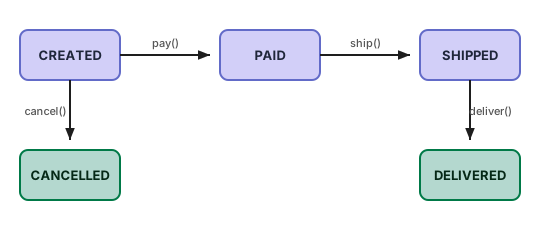
Here is how we can implement this transition ruleset using enums:
public enum OrderState {
    CREATED {
        @Override
        public boolean canTransitionTo(OrderState nextState) {
            return nextState == PAID || nextState == CANCELLED;
        }
    },
    PAID {
        @Override
        public boolean canTransitionTo(OrderState nextState) {
            return nextState == SHIPPED;
        }
    },
    SHIPPED {
        @Override
        public boolean canTransitionTo(OrderState nextState) {
            return nextState == DELIVERED;
        }
    },
    DELIVERED {
        @Override
        public boolean canTransitionTo(OrderState nextState) {
            return false; // Final state
        }
    },
    CANCELLED {
        @Override
        public boolean canTransitionTo(OrderState nextState) {
            return false; // Final state
        }
    };

    // Enforces the transition ruleset
    public abstract boolean canTransitionTo(OrderState nextState);
}
2. Thread-Safe Singletons
In object-oriented design, we sometimes require a class to have only a single, globally accessible instance (e.g., a configuration manager or database connection pool).
Defining a singleton as a single-element enum is a clean, robust approach. The underlying runtime environment handles the creation, thread safety, and serialization protection automatically, preventing multiple instances from being created:
public enum ConfigurationManager {
    INSTANCE;

    private Map<String, String> settings;

    private ConfigurationManager() {
        this.settings = new HashMap<>();
        // Load settings here
    }

    public String getSetting(String key) {
        return settings.get(key);
    }
}
Summary
- Type Safety: Enums constrain input values to a predefined set of valid choices at compile-time.
- Rich States: Enums can encapsulate both fields (metadata) and methods, making them self-contained domain objects.
- Polymorphic Behavior: Abstract methods in enums allow individual constants to define their own execution logic, eliminating messy switch blocks and satisfying the Open-Closed Principle.
- State Machines & Singletons: Enums are primary building blocks for enforcing state transitions and implementing thread-safe global instances.