Encapsulation
Encapsulation in Low-Level Design, covering data hiding, access control, and the "Tell, Don't Ask" design principle.
In object-oriented system design, Encapsulation is the practice of bundling data (state) and the methods that operate on that data (behavior) into a single unit (a class), while restricting direct access to some of the object's components.
Encapsulation is not just about making fields private and writing getters and setters. It is about protecting object integrity and controlling how state is modified.
This article covers how encapsulation protects domain models and explores the Tell, Don't Ask design guideline.
The Encapsulation Barrier
Encapsulation creates a protective barrier around an object's state. The outside world can only interact with the object through its public interface (methods), while the internal fields remain hidden.
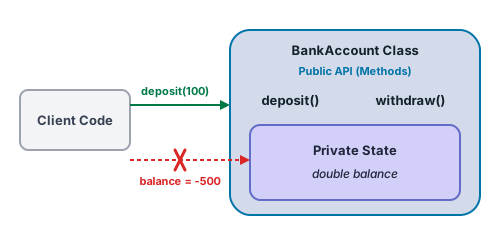
This design choice provides two key benefits:
- Validation & Integrity: The class can enforce rules on how its data changes, preventing it from entering an invalid state (e.g., a negative bank account balance).
- Flexibility to Change: We can change the internal data structures of a class without modifying the external classes that use it.
Code Example: Protecting State
The Anti-Pattern: Public Access
If fields are public, any external code can modify them arbitrarily, bypassing business rules:
public class BankAccount {
    public double balance; // Exposed!
}

// Client usage:
BankAccount account = new BankAccount();
account.balance = -500.00; // Invalid state allowed!
The LLD Pattern: Encapsulated State
By making fields private and exposing controlled methods, we protect the object's integrity:
public class BankAccount {
    private double balance; // Hidden state

    public double getBalance() {
        return this.balance;
    }

    public void deposit(double amount) {
        if (amount <= 0) {
            throw new IllegalArgumentException("Deposit amount must be positive.");
        }
        this.balance += amount;
    }

    public void withdraw(double amount) {
        if (amount <= 0) {
            throw new IllegalArgumentException("Withdrawal amount must be positive.");
        }
        if (amount > this.balance) {
            throw new IllegalStateException("Insufficient funds.");
        }
        this.balance -= amount;
    }
}
[!WARNING] Getters and Setters are not a Silver Bullet Automatically generating getters and setters for every private field is a common mistake. If a setter allows anyone to change a field to any value, it breaks encapsulation.
- Only expose getters and setters when absolutely necessary.
- Prefer exposing business-focused methods (e.g.,
deposit()) over raw setters (e.g.,setBalance()).
The "Tell, Don't Ask" Guideline
A core guideline of encapsulation in LLD is Tell, Don't Ask.
Instead of asking an object about its internal state, making a decision, and then updating the object's state from the outside, we should simply tell the object what action to perform. This keeps the behavior encapsulated where the data lives.
Anti-Pattern (Asking):
// Client asks for the wallet balance, makes a decision, and updates it
if (wallet.getBalance() >= itemPrice) {
    wallet.setBalance(wallet.getBalance() - itemPrice);
}
Pattern (Telling):
// Client tells the wallet what to do
wallet.deduct(itemPrice);
By delegating the logic to the Wallet class, we prevent business rules (like checking for sufficient funds) from leaking into external classes.
Summary
- Encapsulation: Bundles state and behavior together, hiding internal details.
- Data Integrity: Restricting direct access ensures objects can validate changes and maintain valid states.
- Tell, Don't Ask: Keep logic next to the data it operates on by telling objects what to do rather than asking for their state.